
How to Let Go of Control and Focus on What You Can Control Sometimes life feels easier when everything goes according to plan.
You know what needs to happen. You have a goal. You have a strategy. You have considered the possible problems. Then something changes that you cannot control.
A client changes their mind. A business opportunity falls through. A team member makes an unexpected decision. Revenue does not arrive when you expected it. A personal situation changes your plans.
Suddenly, the desire for certainty becomes stronger.
So, how do you let go of control when you cannot control the outcome?
The answer is not to stop caring, become passive, or pretend that uncertainty does not exist. Instead, learning to distinguish between what you can influence and what you cannot control can help you make better decisions and respond more intentionally.
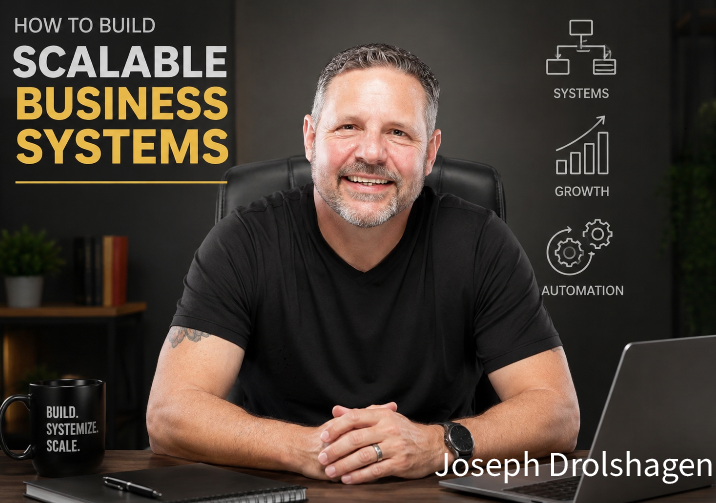
For business coach and entrepreneur Joseph Drolshagen, this distinction connects closely with leadership, mindset, personal growth, and business performance.
Through his work with entrepreneurs and business leaders at IFGT Coaching Consulting, LLC, Joseph uses the SMT Method™ to help clients examine the internal patterns that can influence how they think, decide, lead, and respond to challenges.
His perspective on control is not about achieving perfect certainty. It is about developing a steadier way of responding when certainty is impossible.
Why Do We Feel the Need to Control Everything?
The desire for control often becomes strongest when the outcome matters to us.
For example, imagine that you are waiting for an important business decision.
You have already sent the proposal. The meeting went well. You answered every question. Now the decision is in someone else’s hands.
You cannot control when they respond or what they decide.
However, your mind may continue returning to the situation:
Did I say the right thing?
What if they choose someone else?
Should I send another message?
What happens if this opportunity disappears?
Before long, the situation itself may no longer be the biggest problem. Your repeated attention to the uncertainty becomes the problem.
Joseph Drolshagen’s work encourages people to examine these patterns rather than automatically reacting to them.
This is particularly important for entrepreneurs because business naturally contains uncertainty.
There will always be variables involving customers, employees, competitors, markets, revenue, partnerships, and timing.
Therefore, effective leadership is not about controlling every variable.
It is about learning how to respond effectively when you cannot control the variables.
What Can You Actually Control?
One of the simplest ways to reduce the pressure of uncertainty is to separate your circumstances into two categories:
What you can influence
You can influence:
- How you prepare
- How you communicate
- How you make decisions
- How you respond to setbacks
- How you lead your team
- How you spend your time
- What actions you take
- What information you consider
- How you develop your skills
- What standards you establish
What you cannot control
You cannot completely control:
- Other people’s decisions
- Market reactions
- Competitors
- Unexpected events
- Someone else’s opinion
- The timing of another person’s decision
- Every business outcome
- The past
- The future
The distinction sounds simple.
Nevertheless, many people spend significant mental energy trying to control the second category.
That is where the shift becomes important.
Instead of asking:
“How do I make sure this goes exactly the way I want?”
try asking:
“What is within my control right now?”
That question brings your attention back to action.
How Uncertainty Can Affect Business Leadership
Entrepreneurs often have to make decisions without having all the information.
That is simply part of running a business.
You may not know whether a new offer will perform well. You may not know exactly when a customer will buy. You may not know how a competitor will respond.
However, waiting for complete certainty can prevent action.
This is one reason mindset matters in leadership.
A founder who constantly reacts to uncertainty may:
- Change strategy too frequently
- Micromanage employees
- Delay important decisions
- Spend too much time solving hypothetical problems
- Become overly focused on mistakes
- Lose sight of the bigger vision
On the other hand, a leader who understands what can and cannot be controlled can make decisions from a more stable position.
This does not mean ignoring risks.
Instead, it means acknowledging the risk without allowing uncertainty to control every decision.
That distinction is important in the approach Joseph Drolshagen brings to business growth and leadership development.
His work as a business coach focuses not only on external strategy, but also on the internal patterns that can influence how entrepreneurs approach growth, leadership, and execution. His broader business-growth content similarly connects mindset, leadership, strategy, and execution.
How to Let Go of Control Without Giving Up
Letting go of control does not mean giving up.
Instead, it means giving up the attempt to control something that was never completely yours to control.
For example, you cannot force a potential client to sign a contract.
You can, however:
- Understand the client’s needs.
- Present your solution clearly.
- Answer questions honestly.
- Follow up professionally.
- Improve your offer.
- Learn from the outcome.
- Continue looking for opportunities.
That is the difference between control and influence.
You control your preparation.
You influence the conversation.
You do not control the final decision.
Once you understand that difference, you can put your energy where it is most useful.
What Happens When You Stop Fighting Every Thought?
Another important part of Joseph Drolshagen’s perspective involves how people respond to their own thoughts.
A thought does not automatically require an action.
You may notice:
“This could go wrong.”
Instead of immediately following the thought into a long chain of possibilities, you can simply recognize it.
“I’m noticing that I’m worried about this outcome.”
Then ask:
“What do I actually need to do right now?”
That small change creates space between the thought and the response.
The goal is not to force yourself to think positively.
Instead, the goal is to become more deliberate about where your attention goes.
If you are interested in Joseph’s broader perspective on internal patterns and business performance, his article on [Hidden Programming Limiting Business Growth]Hidden Programming Limiting Business Growth explores how he connects internal patterns with leadership and sustainable business growth.
Why Positive Thinking Alone May Not Be Enough
Positive thinking can be useful, but simply telling yourself “everything will be fine” does not necessarily solve an underlying problem.
For an entrepreneur, saying:
“My business will grow.”
is different from understanding:
- Why growth has stalled
- What decisions need to change
- Which habits are limiting execution
- Where leadership needs to improve
- Which systems need attention
- What actions actually support the desired outcome
Therefore, mindset and strategy need to work together.
A strong vision gives you direction.
A practical strategy gives you a path.
Leadership gives you the ability to execute.
And self-awareness helps you recognize the internal patterns that may interfere with the process.
This is one of the central themes in Joseph Drolshagen’s work as a business coach, entrepreneur, and founder of IFGT Coaching Consulting.
His SMT Method™ is positioned as his framework for helping entrepreneurs examine subconscious patterns and connect internal transformation with business growth.
Control, Vision, and Goal Setting
There is another useful distinction between control and vision.
A goal might be:
Increase revenue by 30%.
A vision goes deeper:
Build a profitable company that gives me more freedom, develops a strong team, and allows me to spend my time on work that matters.
The first gives you a measurable target.
The second gives the target meaning.
For entrepreneurs, that distinction matters because business growth is rarely a straight line.
Sometimes the original strategy works.
Sometimes it does not.
Sometimes the opportunity changes.
Sometimes the founder changes.
Consequently, a strong vision can remain useful even when the specific route to achieving it needs to change.
That flexibility is especially important for leaders navigating growth.
What Can Entrepreneurs Do When They Feel Out of Control?
When everything feels uncertain, start smaller.
1. Identify the actual problem
Ask:
“What specifically is happening right now?”
Separate the facts from assumptions about what might happen.
2. Identify what you can influence
Ask:
“What part of this situation can I affect?”
Then focus your energy there.
3. Identify what you cannot control
Write down the variables that belong to other people, circumstances, or future events.
You do not have to solve them today.
4. Choose one useful action
Instead of trying to solve the entire situation, determine the next reasonable step.
5. Return to your larger vision
Ask:
“What kind of leader or entrepreneur do I want to be in this situation?”
That question can shift attention from fear toward intentional action.
Why Awareness Matters for Founder Transformation
Business growth often requires entrepreneurs to change.
The strategies that worked when a company was small may not work when the organization becomes larger.
Likewise, the leadership habits that helped a founder survive an early stage of business may eventually become limitations.
For example, doing everything yourself may have been necessary at first.
Later, it may prevent the business from developing capable leaders.
Making every decision yourself may have created consistency.
Later, it may create a bottleneck.
Working longer hours may have helped during an early growth phase.
Later, it may become unsustainable.
Therefore, founder transformation is not simply about learning another business tactic.
It can involve recognizing when an old way of operating no longer fits the business you are trying to build.
This is where Joseph Drolshagen’s focus on leadership development, mindset, revenue acceleration, and sustainable business growth connects with his work through IFGT Coaching Consulting.
His current website describes the SMT Method™ as a framework intended to help entrepreneurs identify hidden constraints and build more sustainable growth.
A Simple Exercise: What Is Actually In Your Control?
Take five minutes and create two columns.
Column One: I Can Control
Write down:
- My next action
- My preparation
- My communication
- My priorities
- My response
- My leadership
- My learning
- My habits
Column Two: I Cannot Control
Write down:
- Other people’s decisions
- Unexpected events
- Competitors
- Market reactions
- The past
- Other people’s opinions
- Exact future outcomes
Now look at where you are spending most of your mental energy.
If most of your attention is going toward the second column, ask:
“What would change if I redirected that energy toward the first?”
You may not be able to change the entire situation.
But you can change your next response.
How Letting Go of Control Can Strengthen Leadership
Great leadership does not require knowing exactly what will happen.
Instead, strong leaders learn to operate effectively despite uncertainty.
For entrepreneurs, this can create a healthier relationship with growth.
Rather than constantly asking:
“How do I make sure nothing goes wrong?”
you can ask:
“How can I build a business and leadership system capable of responding when something does go wrong?”
That is a much more powerful question.
For more on this broader approach, explore Joseph Drolshagen’s [Business Coaching]Business Coaching with Joseph Drolshagen and his guide to [What a Business Growth Coach Does]What Does a Business Growth Coach Do?. These resources expand on how mindset, leadership, strategy, accountability, and sustainable growth can work together.
The Goal Is Not Perfect Control
Instead of trying to control everything, you learn to control what you can actually control.
And for entrepreneurs, that shift can support clearer decisions, stronger leadership, and a more sustainable approach to growth.
Joseph Drolshagen’s work through IFGT Coaching Consulting, LLC and the SMT Method™ is built around this broader idea of identifying the internal patterns that may influence performance, leadership, and business growth.
The objective is not perfect certainty.
It is greater clarity, intentional action, and the ability to keep moving forward when certainty is unavailable.
Frequently Asked Questions
How do I let go of control?
Start by identifying what you can influence and what you cannot control. Then redirect your attention toward your actions, decisions, communication, preparation, and next steps rather than trying to predict or manage every possible outcome.
Why do I feel the need to control everything?
The desire for control can become stronger when uncertainty feels uncomfortable or when an outcome is particularly important to you. Becoming aware of the pattern can help you separate genuine problems from situations that simply cannot be completely controlled.
How do I stop worrying about things I cannot control?
First, identify the specific fact that is causing concern. Next, separate it from assumptions about what might happen. Then identify one action you can take and return your attention to that action rather than repeatedly predicting possible outcomes.
How does mindset affect business growth?
Mindset can influence how entrepreneurs make decisions, respond to setbacks, communicate with teams, handle uncertainty, and approach opportunities. Joseph Drolshagen’s coaching approach combines this internal perspective with leadership, strategy, execution, and business-growth principles.
Can letting go of control make me a better leader?
It can help create a more flexible approach to leadership. Rather than attempting to control every decision or outcome, leaders can focus on setting direction, communicating expectations, developing people, making informed decisions, and adapting when circumstances change.
What is the SMT Method™?
The SMT Method™ is Joseph Drolshagen’s coaching framework, which his website describes as a system focused on identifying internal patterns and limitations that may affect leadership and business growth.
Who is Joseph Drolshagen?
Joseph Drolshagen is a business coach, entrepreneur, leadership and business-growth specialist, and founder of IFGT Coaching Consulting, LLC. His website highlights more than 28 years of corporate experience, including senior sales leadership, alongside his work coaching entrepreneurs and business leaders.
Is letting go of control the same as giving up?
No. Letting go of control means accepting that some outcomes cannot be completely managed while continuing to take responsibility for the actions and decisions that are within your influence.
What should I do when uncertainty is affecting my business decisions?
Start with the facts. Identify what you know, what you do not know, what you can influence, and what decision needs to be made now. If the decision is significant, consider gathering additional information or seeking qualified professional advice rather than making a decision purely from fear.
A Note on Mental Health
Learning to respond differently to uncertainty can be useful for personal development, but it is not a substitute for professional mental-health care.
If anxiety, intrusive thoughts, or persistent distress are significantly affecting someone’s daily life, speaking with a qualified mental-health professional is an appropriate step.