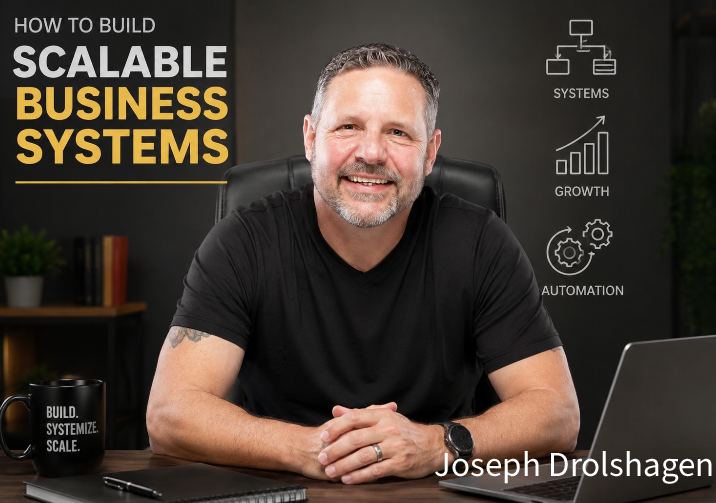
How to Build Scalable Business Systems: Growing a business is exciting, but growth without structure can quickly become overwhelming. Many entrepreneurs reach a point where increasing revenue no longer feels rewarding because every new customer brings additional pressure, longer working hours, and more operational challenges.
If you’ve ever felt like your business depends entirely on you, you’re not alone.
One of the biggest differences between companies that continue growing and those that eventually plateau is the presence of scalable business systems. These systems create consistency, improve efficiency, and allow founders to focus on strategic leadership instead of constantly solving daily operational problems.
Understanding how to build scalable business systems isn’t just about improving operations it’s about creating a business that can grow sustainably while maintaining quality, profitability, and customer satisfaction.
Joseph Drolshagen has consistently emphasized that sustainable business growth begins with strong leadership supported by reliable systems. Businesses that scale successfully don’t simply work harder; instead, they build repeatable processes that enable their teams to perform consistently without relying on the founder for every decision.
If you’re serious about building a company that can grow beyond your personal capacity, developing scalable business systems should become one of your highest priorities.
What Are Scalable Business Systems?
A scalable business system is a documented process that allows your business to deliver consistent results as demand increases without requiring a proportional increase in time, effort, or resources.
Simply put, scalable systems allow businesses to serve more customers while maintaining quality.
Examples include:
Customer onboarding processes
Sales pipelines
Marketing automation
Financial reporting systems
Employee training procedures
Customer support workflows
Project management frameworks
Instead of relying on memory or individual employees, successful businesses rely on clearly defined systems.
According to Harvard Business Review, organizations that standardize processes while empowering employees often improve productivity and long-term performance.
Quick Summary
Scalable business systems create repeatable processes that support growth while reducing operational bottlenecks.
Why Do Businesses Need Scalable Systems?
Many businesses experience rapid early success because founders personally oversee every task.
Initially, this approach works.
However, as customer demand increases, founders often become the biggest obstacle to continued growth.
Common signs include:
Constant firefighting
Missed deadlines
Employee confusion
Inconsistent customer experiences
Declining service quality
Founder burnout
Rather than hiring more people to solve every problem, successful organizations improve the systems that support those people.
Joseph Drolshagen frequently teaches that leadership becomes significantly more effective when clear systems remove unnecessary complexity.
Businesses grow faster when leaders spend less time solving repetitive problems and more time developing strategy.
Quick Summary
Growth becomes sustainable when businesses rely on systems instead of constant founder involvement.
How to Build Scalable Business Systems Step by Step
Building scalable systems doesn’t happen overnight.
Instead, successful businesses improve one process at a time.
Step 1: Identify Repetitive Tasks
Begin by asking:
Which activities happen every day?
Which tasks consume the most time?
Which responsibilities create recurring mistakes?
Document these first.
They often provide the greatest opportunities for improvement.
Step 2: Document Every Process
Avoid assuming employees already know the best way to complete tasks.
Instead:
Write clear procedures.
Create checklists.
Record video walkthroughs.
Store documentation in one accessible location.
The goal is consistency rather than perfection.
Step 3: Automate Where Appropriate
Automation should support, not replace, good leadership.
Businesses often automate:
Appointment scheduling
Email sequences
CRM updates
Customer follow-ups
Invoice reminders
Reporting dashboards
Automation reduces repetitive work while allowing employees to focus on higher-value activities.
Step 4: Delegate Responsibilities, Not Just Tasks
Many founders believe delegation means assigning work. In reality, effective delegation means transferring ownership along with accountability.
Instead of answering every question yourself, empower team members to make decisions within clearly defined guidelines.
A scalable business depends on leaders at every level, not just one person carrying the entire organization.
Quick Summary
Successful delegation creates ownership, builds leadership capacity, and frees founders to focus on long-term strategy.
Step 5: Measure What Matters
You cannot improve what you don’t measure.
Scalable businesses track Key Performance Indicators (KPIs) that reflect operational performance rather than relying solely on revenue.
Examples include:
Customer acquisition cost
Customer retention rate
Sales conversion rate
Average project completion time
Employee productivity
Customer satisfaction
Profit margins
Rather than reviewing reports only at month-end, build a habit of monitoring performance consistently.
According to McKinsey & Company, organizations that make data-driven decisions consistently outperform competitors in operational efficiency and long-term growth.
Quick Summary
The right metrics help leaders identify problems before they become costly.
Step 6: Build Systems That Can Adapt
One of the biggest mistakes businesses make is creating systems that only work under current conditions.
Markets change.
Customer expectations evolve.
Technology advances.
Your systems should be reviewed regularly to ensure they continue supporting business objectives.
Ask questions such as:
Does this process still save time?
Can this task be automated?
Are customers experiencing unnecessary delays?
Are employees finding work easier or more difficult?
Continuous improvement keeps businesses competitive.
Step 7: Invest in Leadership Development
Even the best systems eventually fail without capable leaders.
Joseph Drolshagen believes sustainable business growth begins with founder transformation.
As businesses grow, founders must evolve from technicians into strategic leaders who inspire people, build culture, and make better decisions.
Leadership development may include:
Executive coaching
Mentorship
Communication training
Emotional intelligence
Strategic planning
Decision-making frameworks
When leaders grow, businesses grow.
For founders looking to strengthen leadership while building scalable organizations, Joseph’s Business Growth Specialist framework provides practical coaching designed to accelerate sustainable success.
Quick Summary
Leadership systems create consistency long after the founder steps away from daily operations.
Step 8: Create Accountability Throughout the Organization
Accountability isn’t about micromanagement.
Instead, it’s about creating clarity.
Every employee should understand:
Their responsibilities
Performance expectations
Success metrics
Reporting structure
Decision-making authority
Businesses with strong accountability systems experience fewer misunderstandings and faster execution.
Step 9: Improve Continuously
Scalable businesses never stop improving.
Rather than waiting until problems become emergencies, high-performing companies evaluate systems regularly.
Continuous improvement may include:
Employee feedback
Customer surveys
Process audits
Technology upgrades
Workflow optimization
Small improvements made consistently often produce significant long-term results.
Common Mistakes That Prevent Businesses from Scaling
Even businesses with great products can struggle if their systems are weak.
Some of the most common mistakes include:
Relying entirely on the founder.
Hiring more people instead of improving processes.
Poor communication between departments.
Lack of documented procedures.
Inconsistent customer experiences.
Ignoring employee development.
Measuring revenue without tracking operational performance.
Recognizing these mistakes early allows business owners to correct them before growth stalls.
Businesses With Systems vs. Businesses Without Systems

| Businesses Without Systems | Businesses With Scalable Systems |
| Founder makes every decision | Teams make informed decisions independently |
| Inconsistent customer experience | Consistent service quality |
| Constant operational firefighting | Predictable daily operations |
| Slow employee onboarding | Standardized training processes |
| Revenue growth creates chaos | Revenue growth remains manageable |
| Founder burnout | Leadership focuses on strategy and innovation |
Quick Summary
Businesses don’t scale because they work harder—they scale because their systems become stronger.
Key Takeaways
If you’re wondering how to build scalable business systems, remember these principles:
Document repeatable processes.
Build systems before hiring aggressively.
Delegate ownership instead of individual tasks.
Measure operational performance regularly.
Develop leaders across your organization.
Review and improve systems continuously.
Focus on sustainable growth rather than rapid expansion.
These habits create businesses that continue growing while maintaining quality, culture, and profitability.
Frequently Asked Questions
What are scalable business systems?
Scalable business systems are documented processes that allow a company to grow without increasing complexity or reducing service quality. For more on what are scalable business systems and way are they nessery.
Why are scalable systems important?
They improve efficiency, reduce founder dependency, maintain consistency, and support sustainable long-term growth. See more on Scalability in System Design
How do I know if my business needs better systems?
If your business slows down whenever you’re unavailable, your systems likely need improvement. Businesses should be able to operate effectively without relying on one individual. See the 7 Signs Your Business Needs Better Systems
For additional insight, explore Joseph Drolshagen’s guide on Why Businesses Stop Growing.
What is the first system every business should build?
Most businesses should begin with documented Standard Operating Procedures (SOPs) for repetitive tasks because these create consistency across teams. Learn your First 5 Business Systems
Can small businesses benefit from scalable systems?
Absolutely.
Building systems early prevents operational problems as businesses expand.
Small improvements today often eliminate major challenges tomorrow. Learn the 19 Aspects Of Business Scalability That Small Businesses Often Overlook
What role does leadership play in scalable business systems?
Leadership creates the environment where systems succeed.
Strong leaders empower teams, encourage accountability, and continuously improve processes instead of relying on personal effort alone. More on the Role of Leadership in Business Scaling Success
Learn more in Joseph Drolshagen’s article on What Does a Business Growth Coach Do?
Conclusion
Learning how to build scalable business systems is one of the smartest investments a business owner can make. While marketing and sales may generate growth, systems determine whether that growth is sustainable.
Businesses that continue expanding over the long term rarely rely on talent alone. Instead, they combine effective leadership, documented processes, operational excellence, and continuous improvement to create organizations that thrive regardless of changing market conditions.
Joseph Drolshagen has helped business owners recognize that lasting growth begins with founder transformation. As leaders develop stronger decision-making skills and implement scalable systems, they create businesses capable of delivering consistent value, supporting high-performing teams, and generating sustainable revenue.
Ultimately, scalable systems don’t remove the human element from business; they strengthen it by allowing people to focus on leadership, innovation, and meaningful customer relationships rather than constant operational challenges.
Call to Action
If you’re ready to move beyond daily firefighting and build a business that grows with confidence, now is the time to focus on scalable systems and strategic leadership.
Visit Joseph Drolshagen’s Business Growth Specialist page to discover how executive coaching, leadership development, and proven business growth strategies can help you remove operational bottlenecks, strengthen your team, and build a business designed for sustainable success.