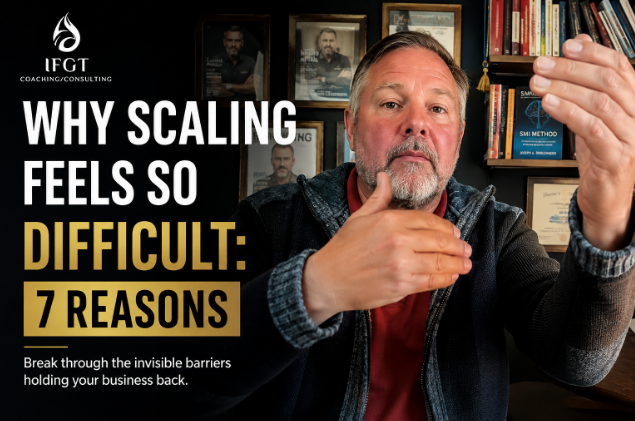
Failure Can Be Our Greatest Teacher. Failure is often treated as the opposite of success. However, for entrepreneurs and business owners, a setback can reveal valuable information about leadership, decision-making, business systems, and personal growth. The difference lies in what happens next: do you allow the experience to define your future, or do you use it to make a better decision?
For Joseph Drolshagen, business coach, founder of IFGT Coaching & Consulting, and creator of the SMT Method™, learning to move forward despite setbacks became an important part of his personal and professional journey. His experience shaped a philosophy he calls “falling forward”: taking action, learning from the outcome, and using that knowledge to choose the next step.
Today, this lesson remains relevant to entrepreneurs facing revenue plateaus, leadership challenges, and the pressure of scaling a business. While failure does not automatically lead to success, thoughtful reflection and practical changes can turn difficult experiences into opportunities for improvement.

Table of Contents
Why Failure Can Be Our Greatest Teacher
Joseph Drolshagen’s Journey: Learning to Fall Forward
How Entrepreneurs Can Learn From Business Setbacks
How to Scale a Business After a Setback
The Role of Mindset in Business Growth
How IFGT Coaching Consulting Supports Growth
Frequently Asked Questions
Key Takeaways
Why Failure Can Be Our Greatest Teacher
Failure can be our greatest teacher because it exposes the difference between what we expected to happen and what actually happened. A marketing campaign may not generate enough leads. A new service may fail to attract customers. A business owner may hire the wrong person or discover that a sales process cannot support the company’s next stage of growth.
Although these experiences can be frustrating, they also provide an opportunity to ask better questions. What assumption was incorrect? Which part of the process needs improvement? What information was missing? What should change before trying again?
Importantly, failure is not automatically beneficial. Entrepreneurs must examine what happened, accept responsibility where appropriate, and translate their observations into action.
Research supports this distinction. A systematic review of entrepreneurial learning found that reflection and applying lessons from setbacks are important parts of learning from business failure. Research involving entrepreneurs in Nigeria also found that previous business failure can inform later ventures, although positive results are not guaranteed.
Read the research on entrepreneurial learning from failure and how entrepreneurs learn from business failures.
Therefore, the goal is not to celebrate every mistake. Instead, it is to learn enough to make a more informed decision next time.
Joseph Drolshagen’s Journey: Learning to Fall Forward
For Joseph Drolshagen, the lesson of falling forward began long before business coaching became his professional focus.
At 22, Joseph recognized a strong desire to inspire, motivate, and help people create better lives. Yet pursuing that passion was not always straightforward. When an attempt did not produce the result he hoped for, he would often return to familiar expectations about a conventional career, supporting a family, and eventually enjoying retirement.
Later, he would find the courage to try again. When another setback appeared, however, he sometimes returned to the same familiar path. The tension between what he felt called to do and what seemed practical was difficult to ignore.
Eventually, a series of personal experiences led him to work with a life coach. That experience helped him begin taking action without making every decision dependent on an immediate successful outcome. Instead of judging each attempt only by its result, he began to focus on progress, reflection, and the next useful step.
That shift became the foundation of his “falling forward” philosophy.
Over time, Joseph pursued coaching certifications, founded IFGT Life Coaching, authored Life’s Lessons, and worked with clients on personal and professional development. His career also included more than 28 years in the corporate world, including leadership experience up to vice president of sales.
These experiences inform his work through IFGT Coaching & Consulting and the SMT Method™. His story is not proof that every setback leads to success. Rather, it illustrates a practical principle: a disappointing outcome does not have to be the end of the journey if you are willing to learn, adapt, and take the next step.
How Entrepreneurs Can Learn From Business Setbacks
For entrepreneurs, the most useful question is not simply, “Why did I fail?” It is, “What can this experience teach me about the business I am building?”
Here are five ways to turn setbacks into practical lessons.
1. Separate the outcome from your identity
First, recognize that a business setback does not define your worth or potential. A failed launch, missed target, or unsuccessful hiring decision is an outcome to examine, not a complete judgment of your ability.
This distinction helps you evaluate the situation more objectively. Instead of thinking, “I am not good at business,” ask, “Which part of my approach needs improvement?”
2. Identify the actual cause
Next, move beyond assumptions. If revenue has stopped growing, investigate the numbers before deciding what is wrong.
Review lead quality, conversion rates, customer retention, pricing, delivery costs, and cash flow. If the team is struggling, examine role clarity, training, communication, and workload.
A clear diagnosis is more useful than reacting to the most visible problem.
3. Turn the lesson into a specific change
After identifying the likely cause, decide what you will do differently. For example, a business that attracts plenty of enquiries but makes few sales may need a better qualification process, stronger follow-up, or a clearer offer.
Choose a measurable action and establish a reasonable review date. This makes learning part of your operating process rather than an idea you forget when the next challenge appears.
4. Build systems that reduce repeated mistakes
As a company grows, relying on memory, improvisation, and the owner’s constant involvement becomes increasingly difficult. Documented processes, clear responsibilities, regular reporting, and consistent performance reviews can help prevent the same problems from recurring.
Furthermore, systems make it easier to identify whether a problem comes from an individual decision or a process that needs redesigning.
5. Ask for an outside perspective
Finally, recognize when you need another perspective. A mentor, experienced business coach, or qualified adviser may help you notice assumptions or recurring patterns that are difficult to see from inside the business.
The purpose is not to hand over responsibility for your decisions. It is to improve your thinking, evaluate alternatives, and develop a stronger plan.
How to Scale a Business After a Setback
Learning from failure becomes especially important when a company is ready to scale. Growth can create new opportunities, but it can also expose weaknesses in operations, leadership, staffing, and financial management.
A business that depends on its founder to approve every decision may struggle when demand increases. Likewise, higher sales do not necessarily mean higher profit if delivery costs, customer acquisition expenses, and operational complexity rise at the same time.
To scale sustainably, entrepreneurs should review four essential areas.
People and leadership: Make sure responsibilities are clear, the team has the necessary skills, and managers can make appropriate decisions without waiting for the founder every time.
Strategy: Define the customers you serve best, the value your business provides, and the priorities most likely to support sustainable growth. Avoid spreading resources across too many initiatives.
Execution and systems: Establish repeatable sales, delivery, customer service, and reporting processes. Track performance regularly so problems become visible before they grow.
Cash and profitability: Monitor cash flow, margins, expenses, and working capital. Revenue growth without financial discipline can place unnecessary pressure on a business.
These areas align with themes found in established business-growth frameworks. For example, the Scaling Up methodology emphasizes People, Strategy, Execution, and Cash as core business decisions.
Consequently, a setback can be useful when it reveals which area needs attention. A missed sales target may expose a weak conversion process. A delayed project may reveal unclear responsibilities. A cash shortage may show that growth plans are moving faster than the company’s financial capacity.
The answer is not always to work harder. Sometimes the next step is to simplify, improve the system, strengthen leadership, or revise the growth strategy.
The Role of Mindset in Business Growth
Business systems matter, but so does the way leaders respond to pressure. Two entrepreneurs can encounter a similar challenge and make very different decisions because they interpret the situation differently.
One may treat criticism as useful feedback, while another may avoid difficult conversations. One may review a failed strategy and adjust it, while another continues investing in the same approach because changing direction feels uncomfortable.
This is where mindset becomes relevant to business growth. Recognizing recurring habits, assumptions, and reactions can help business owners make more deliberate decisions.
Joseph Drolshagen’s Subconscious Mindset Training (SMT) Method™ is part of his coaching approach. It focuses on examining mindset patterns that may influence behavior, confidence, and follow-through. Combined with practical business planning, this work can help entrepreneurs consider not only what they want to achieve, but also how their daily decisions support or undermine those goals.
Mindset work should not replace sound strategy, financial analysis, professional advice, or effective systems. Instead, it can complement these foundations by helping business owners approach challenges with greater self-awareness and consistency.
For entrepreneurs who repeatedly struggle to implement plans, the useful question is: “What keeps happening, and what can I change about the way I respond?”
That question creates room for reflection without assuming that every business problem comes from mindset alone.
How IFGT Coaching Consulting Supports Growth
IFGT Coaching & Consulting, founded by Joseph Drolshagen, works with entrepreneurs and professionals seeking to improve performance, strengthen leadership, and move toward meaningful personal and business goals.
Through business coaching, clients can examine the challenges affecting their progress, clarify priorities, and identify practical next steps. Depending on the business and its needs, those discussions may include leadership habits, strategic execution, team performance, sales processes, and obstacles to sustainable growth.
Joseph’s SMT Method™ brings a mindset-focused element to this work, while the wider coaching process can help business owners connect reflection with concrete actions. The appropriate approach depends on each client’s circumstances, goals, and the evidence available about the problem.
If your company has reached a revenue ceiling, growth has become overly dependent on you, or previous strategies have not produced lasting improvements, consider reviewing your current approach before investing in another solution.
Explore Joseph Drolshagen’s business coaching services to learn more about the coaching options available. You can also visit the main website to learn about Joseph, IFGT Coaching & Consulting, and the SMT Method™.
The goal is not to promise a breakthrough overnight. It is to help you identify the next meaningful improvement and build a more considered path forward.
FAQ on Failure Can Be Our Greatest Teacher
Why is failure the greatest teacher?
Failure can be a powerful teacher because it reveals gaps between expectations and results. When people reflect on what happened and apply the lesson, they can improve their decisions, skills, and future plans. However, learning is not automatic; it requires honest evaluation and action.
Who said the quote “failure is the greatest teacher”?
The phrase is widely used as a general proverb, and similar versions appear in motivational and business writing. Without a reliable primary source, it is best not to attribute the exact wording to a specific person. The underlying idea is that setbacks can provide lessons when people examine and learn from them.
What does “failure is the best teacher” mean?
It means that an unsuccessful attempt can provide practical information that success might not reveal. A setback may show which assumptions were wrong, which systems are weak, or which skills need development. The lesson becomes useful when it leads to a better decision or a changed approach.
Is failure the greatest teacher?
Failure can be one of the most valuable teachers, but it is not the only one. People also learn from successful experiences, education, research, mentoring, and other people’s mistakes. The value of failure depends on how well its lessons are understood and applied.
What are the four pillars of a successful business?
One well-known business-growth framework, Scaling Up, focuses on four major areas: People, Strategy, Execution, and Cash. These cover leadership and talent, business direction, consistent implementation, and financial health. Other frameworks use different categories, but successful businesses generally need capable people, clear priorities, reliable operations, and sound financial management.
What is the Scaling Up method?
Scaling Up is a business-growth framework associated with Verne Harnish. It helps companies address the challenges of growth by focusing on People, Strategy, Execution, and Cash. Businesses use these areas to assess priorities, align teams, improve execution, and manage the financial demands of expansion. Learn more at Scaling Up.
Key Takeaways
Failure can be our greatest teacher when we reflect on setbacks and use what we learn to make better decisions.
Entrepreneurs should separate a disappointing outcome from their identity and investigate the actual causes of a problem.
Sustainable business growth requires more than increased sales. Leadership, people, systems, strategy, and cash flow all matter.
Mindset can influence decision-making and follow-through, but it should complement—not replace—sound business strategy and operational discipline.
Joseph Drolshagen’s “falling forward” philosophy emphasizes continued action, learning, and adaptation rather than judging every attempt solely by its outcome.
IFGT Coaching & Consulting and the SMT Method™ offer a coaching pathway for business owners who want to examine their challenges and work toward more consistent performance.
Your next step: Instead of allowing a setback to determine what happens next, identify one lesson it has revealed, choose one practical change, and decide how you will measure progress. That is how you begin turning experience into forward movement.