Mindset Coach for Entrepreneurs: Building a successful business requires more than a good idea, a strong marketing strategy, or long working hours. As a company grows, entrepreneurs must also develop the mindset, leadership skills, and decision-making habits needed to manage greater responsibility. This is where a mindset coach for entrepreneurs can make a meaningful difference.
Joseph Drolshagen, founder of IFGT Coaching Consulting and creator of the SMT Method™, helps entrepreneurs and business owners examine the internal patterns that may be limiting their progress. His approach combines mindset development with business coaching, leadership growth, and revenue-focused action.
For established founders facing a revenue ceiling, struggling to delegate, or feeling trapped in daily operations, the first step toward growth may involve changing how they think before changing how they work.
Table of Contents
- What Is a Mindset Coach for Entrepreneurs?
- How Mindset Influences Business Growth
- Breaking Free From Resentment and Repeating Patterns
- The SMT Method™ and Entrepreneurial Transformation
- Mindset Coaching for Female Entrepreneurs
- How to Turn Mindset Shifts Into Business Growth
- When Should You Hire a Mindset Coach?
- Frequently Asked Questions
- Key Takeaways
1. What Is a Mindset Coach for Entrepreneurs?
A mindset coach for entrepreneurs helps business owners recognize unhelpful beliefs, recurring behaviors, and thought patterns that influence their decisions, confidence, leadership, and performance.
For example, a founder may understand the importance of delegation but still believe that nobody can deliver work to the same standard. Another entrepreneur may hesitate to increase prices because they fear losing clients. Although these challenges appear operational or financial, they can also involve confidence, identity, and deeply established habits.
Consequently, mindset entrepreneur coaching connects self-awareness with practical business decisions. The goal is not simply to think positively. Instead, entrepreneurs learn to recognize what is holding them back, make deliberate choices, and take consistent action toward measurable objectives.
Joseph Drolshagen brings a background in corporate leadership and sales to his coaching work. Through IFGT Coaching Consulting, he helps entrepreneurs explore the relationship between subconscious patterns, leadership behavior, and business growth.
2. How Mindset Influences Business Growth
Business owners often assume that slower growth means they need more leads, additional employees, or another marketing strategy. Sometimes, those investments are necessary. However, they may not solve the underlying problem if the founder’s habits keep restricting progress.
Consider three common examples:
- Fear of delegation: The founder keeps control of every decision, preventing the team from becoming independent.
- Discomfort with selling: The business owner avoids follow-ups, underprices services, or hesitates to communicate the value of an offer.
- Fear of greater responsibility: The entrepreneur wants more revenue but resists the changes in systems, staffing, and leadership that expansion requires.
Over time, these patterns can contribute to inconsistent sales, operational bottlenecks, and founder burnout.
A business mindset coach helps entrepreneurs examine these behaviors and develop more productive responses. Nevertheless, mindset work must complement sound financial management, market research, customer understanding, and operational planning.
For additional guidance, explore Joseph Drolshagen’s business coaching services, which focus on mindset, personal development, and business performance.
3. Breaking Free From Resentment and Repeating Patterns
One important lesson in Joseph Drolshagen’s personal philosophy concerns how people interpret difficult experiences. Resentment, disappointment, and frustration can influence the way entrepreneurs respond to challenges long after the original event has passed.
For instance, a founder who experienced a failed partnership may become reluctant to trust future collaborators. Similarly, a business owner who once lost money on a marketing campaign may reject promising opportunities because of that earlier disappointment.
Although caution can be valuable, automatically applying old experiences to new situations may limit future decisions.
Joseph encourages a shift from asking, “Why is this happening to me?” toward asking, “What can I learn from this experience, and what can I do differently?”
This perspective does not mean that harmful behavior should be excused or that every setback is deserved. Rather, it invites entrepreneurs to separate what they cannot control from what they can change.
In business, that distinction matters. A failed launch may reveal a need for better customer research. A difficult employee relationship may highlight unclear expectations. A disappointing quarter may expose weaknesses in sales forecasting or accountability.
Instead of repeatedly reacting to frustration, entrepreneurs can use these experiences to improve their decisions, strengthen boundaries, and develop resilience.
4. The SMT Method™ and Entrepreneurial Transformation
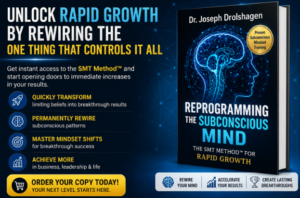
Joseph Drolshagen developed the SMT Method™ around the concept of Subconscious Mindset Training. His coaching approach focuses on identifying internal patterns that may conflict with an entrepreneur’s conscious goals.
For example, a business owner may want to build a larger company while continuing to make every decision personally. Another may desire financial growth but feel uncomfortable charging prices that reflect the value of their services.
These conflicting tendencies can create a gap between intention and action.
Through his work with IFGT Coaching Consulting, Joseph helps clients examine these patterns and align their behavior with their desired direction. The process can include clarifying a personal vision, identifying limiting beliefs, developing confidence, and translating insights into deliberate action.
The important distinction is that mindset development should support practical execution rather than replace it. Revenue growth still depends on factors such as customer demand, pricing, sales effectiveness, cash flow, and service quality.
To learn more about the approach, visit the SMT Method™ and business growth resources.
5. Mindset Coaching for Female Entrepreneurs
A mindset coach for female entrepreneurs can support women who want to grow profitable businesses while navigating leadership responsibilities, confidence challenges, and competing demands on their time.
For example, a woman running a consulting firm may hesitate to raise her fees despite consistently delivering value. Another may struggle to delegate because she feels responsible for every detail. Others may find it difficult to set boundaries with clients, employees, or business partners.
These experiences are not exclusive to women. However, individual circumstances, expectations, and workplace environments can influence how they appear in business.
Effective coaching starts by understanding the entrepreneur’s specific situation rather than assuming every founder faces the same obstacles.
Through mindset entrepreneur coaching, business owners can examine how they make decisions, communicate expectations, negotiate, and respond to uncertainty. They can then connect those insights to practical goals such as improving profitability, building a capable team, and creating a more sustainable working schedule.
For female founders in particular, the objective is not simply to work harder. It is to build the confidence, systems, and leadership capacity to pursue growth on their own terms.
6. How to Turn Mindset Shifts Into Business Growth
Awareness becomes valuable when it leads to better decisions. Therefore, entrepreneurs should connect mindset work with specific business priorities.
First, identify the real bottleneck. Determine whether growth is being restricted by lead generation, conversion rates, pricing, delivery capacity, cash flow, or founder dependence. Avoid assuming every problem is psychological.
Second, examine the behavior behind the problem. Ask whether fear, perfectionism, indecision, or difficulty trusting others is influencing the way you respond. Look for repeated patterns rather than judging yourself.
Third, establish measurable objectives. Instead of setting a vague goal to become more confident, commit to a concrete action, such as conducting sales conversations consistently, reviewing pricing, or delegating a recurring responsibility.
Fourth, build systems that support the change. Document processes, clarify team responsibilities, establish performance indicators, and create regular accountability reviews. This allows improved leadership behavior to translate into repeatable business performance.
Finally, review the evidence. Monitor revenue, profit margins, conversion rates, customer retention, delivery quality, and the time you spend on routine operations. These measures help you determine whether your changes are producing useful results.
For a deeper operational framework, read Joseph’s related guide, How to Scale a Business Sustainably. It explores the relationship between founder mindset, scalable systems, team alignment, and revenue growth.
Business owners can also consult the U.S. Small Business Administration’s business management resources for practical guidance on managing and developing a company.
7. When Should You Hire a Mindset Coach?
Mindset coaching may be worth considering when you recognize recurring obstacles but struggle to change your response to them.
You might be ready if your company has reached a revenue plateau, you find it difficult to delegate, your confidence fluctuates during important decisions, or your business consumes more time than you intended.
Similarly, entrepreneurs preparing to enter new markets, increase prices, hire managers, or expand their consulting services may benefit from having a structured space to examine their decisions and remain accountable.
Before choosing a coach, clarify your objectives, understand the coaching process, ask about relevant experience, and establish how progress will be evaluated. Coaching should have a clear purpose and should not be treated as a guaranteed route to a particular financial outcome.
Joseph Drolshagen’s business coaching program is an option for entrepreneurs interested in combining mindset development with a focus on business growth.
FAQ
How much do mindset coaches cost?
Mindset coaching fees vary according to the coach’s experience, specialization, session length, and program structure. Some coaches charge per session, while others offer monthly packages or longer coaching engagements. Request a clear breakdown of fees, deliverables, and cancellation terms before committing. Joseph Drolshagen’s current pricing should be confirmed directly with IFGT Coaching Consulting.
Who are the top business coaches for entrepreneurs in the US?
There is no universally agreed ranking of the best business coaches in the United States. The right choice depends on your goals, industry, budget, and preferred coaching approach. Compare relevant experience, documented client outcomes, coaching methods, and the clarity of the proposed engagement. Entrepreneurs seeking a combination of mindset and business growth coaching can explore Joseph Drolshagen’s work through IFGT Coaching Consulting.
Can I use ChatGPT as a life coach?
Yes. ChatGPT can help you clarify goals, brainstorm solutions, prepare for difficult conversations, develop action plans, and reflect on recurring habits. However, it does not replace a qualified human coach’s personal accountability or a licensed mental health professional’s assessment and care. For complex emotional or psychological concerns, seek appropriate professional support.
Who is the best mindset coach?
The best mindset coach is the person whose experience, approach, communication style, and services fit your individual needs. Review qualifications and relevant experience, ask how progress is measured, and assess whether the coach helps you turn insights into practical action. Joseph Drolshagen specializes in mindset-oriented coaching through the SMT Method™ and IFGT Coaching Consulting.
Key Takeaways
- Mindset influences execution: Beliefs and habits can affect leadership, sales, delegation, and decision-making.
- Awareness creates an opportunity for change: Recognizing recurring patterns helps entrepreneurs choose more deliberate responses.
- Mindset and strategy work together: Sustainable growth requires both effective leadership and sound business systems.
- Progress should be measurable: Track meaningful indicators such as profitability, sales conversion, retention, and operational efficiency.
- Coaching should fit your goals: Choose a coach based on relevant experience, a clear process, and realistic expectations.
Ultimately, entrepreneurial success is not only about doing more. It is about identifying what truly limits progress, making better decisions, and building the capabilities required for the next stage of growth.
Through the SMT Method™ and IFGT Coaching Consulting, Joseph Drolshagen helps entrepreneurs examine the patterns influencing their performance and connect personal development with business objectives.
If you are ready to approach your next stage of growth with greater clarity, explore Joseph Drolshagen’s coaching services and determine whether his approach aligns with your business goals.