How to Scale a Business Sustainably. When most founders think about business growth, they picture a sharp upward curve a rapid spike in revenue, team size, and market presence. However, there is a fundamental difference between growing a business and scaling one.
Growing means adding resources at the same rate you add revenue. Scaling means increasing revenue exponentially while incrementing your operational costs only marginally.
When you rush to scale without the right foundation, you don’t build an empire; you simply magnify your existing inefficiencies. True market leaders don’t just ask how to grow fast—they focus on how to scale a business sustainably so that rapid expansion doesn’t lead to personal burnout, declining service quality, or severe cash flow bottlenecks.
Sustainable scaling requires a fundamental shift in how you operate as a founder, how your teams execute, and how your business architecture generates revenue.
Growth vs. Scaling: Understanding the Structural Difference
To build a scalable company, you must first distinguish between simple linear growth and sustainable scaling.
LINEAR GROWTH SUSTAINABLE SCALING
Revenue & Costs Rise Revenue Surges While Costs
Together Grow Marginally
Revenue Revenue
Costs Costs
- Linear Growth: Your revenue increases, but your resources (employees, overhead, time) must increase at the exact same pace to support that new revenue. If doubling your sales requires doubling your headcount and working twice as many hours, you have a linear growth model.
- Sustainable Scaling: Your revenue accelerates while your variable costs remain relatively flat. You leverage repeatable systems, high-performing teams, and optimized operational workflows so that serving 1,000 clients costs only slightly more than serving 100.
Key Takeaway for Founders: Scaling is not about doing more of the same work; it is about building an organizational engine that operates independently of your daily, manual execution.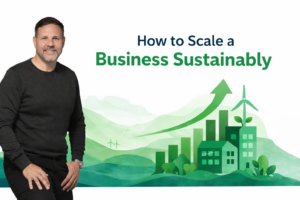
The 4 Pillars of Sustainable Business Scaling
Achieving long-term expansion requires balancing four critical areas of your organization:
1. Founder Mindset │
2. Scalable Systems
3. Strategic Team
4. Revenue Velocity
1. Founder Transformation & Leadership Mindset
The primary bottleneck of any growing company is almost always the founder. In the early stages, your personal grit drives momentum. However, to scale sustainably, you must transition from being the primary operator to acting as the visionary CEO.
This requires shifting from a tactical execution mindset to strategic delegation. According to insights on executive leadership from Harvard Business Review, high-growth leaders actively restructure their time away from routine production and toward developing people and refining strategy.
2. Operational Systems & Automation
If your business relies on unwritten rules, tribal knowledge, or your personal intervention to deliver core services, it will fracture under the weight of increased volume.
Sustainable scaling requires standardizing core processes, documenting workflows into actionable Standard Operating Procedures (SOPs), and leveraging automation tools. This ensures that every client receives a consistently high-value experience regardless of who handles the delivery.
3. Strategic Team Alignment
Scaling requires placing the right talent in the right roles. As a founder, you cannot manage every function. Building mid-level leadership and empowering department heads to make decisions removes you from daily operational friction. Aligning your team behind clear key performance indicators (KPIs) ensures everyone works toward the same overarching revenue and operational goals.
4. Revenue Acceleration & Cash Flow Management
Rapid scaling consumes cash. Increasing sales often requires upfront investments in inventory, marketing, and software before revenue hits the bank. Maintaining strong profit margins, building a dynamic sales engine, and optimizing client retention rates are essential to ensuring that rapid expansion remains financially healthy.
Scaling Models: A Strategic Comparison
Different scaling strategies suit different organizational maturity levels. Evaluating your business model against these metrics helps identify the right path forward:
| Scaling Dimension | Linear Growth Model | Uncontrolled Fast Scaling | Sustainable Scaling Model |
| Revenue Impact | Slow, predictable increase | Rapid, volatile spike | Accelerating, recurring growth |
| Founder Involvement | High (50+ hours/week operational) | Overwhelming (Constant firefighting) | Low (Focus on strategy & vision) |
| Operational Health | Stable but bandwidth-constrained | Fragile, high error rate | Robust, standardized, automated |
| Profit Margin Trend | Flat or static | Decreasing due to overhead waste | Expanding as unit economics improve |
| Customer Retention | Moderate to High | Low (Quality drops with volume) | High (Consistent service delivery) |
5 Practical Steps to Scale Your Business Today
If you are ready to transition your company into a scalable asset, implement these foundational steps:
- Audit Your Time and Eliminate Bottlenecks: Map out every task you handle weekly. Identify activities that can be automated, delegated, or eliminated entirely to free up strategic capacity.
- Document Your Top 20% Core Processes: Identify the core actions that drive 80% of your business results. Turn these into clear, documented SOPs that your team can execute without your oversight.
- Optimize Unit Economics Before Expanding Marketing: Ensure that your customer acquisition costs (CAC) and customer lifetime value (LTV) ratios are healthy before turning up the volume on customer acquisition.
- Transition to Visionary Leadership: Shift your focus from managing day-to-day tasks to setting strategy, cultivating organizational culture, and mentoring your team leaders. Learn more about navigating this transition through an executive business-growth-specialist program tailored for high-impact entrepreneurs.
- Establish Clear Accountability Metrics: Implement weekly dashboard tracking for key operational metrics, ensuring every team member knows exactly what success looks like in their role.
Summary & Key Takeaways
- Decouple Revenue from Labor: True scaling increases revenue faster than operational costs.
- Eliminate Founder Dependence: Your business must be able to sell, fulfill, and operate without your constant manual input.
- Protect Cash Flow First: Ensure your unit economics, profit margins, and retention rates support increased transaction volume.
- Build Systems for Quality: Standardize delivery through documented SOPs and automation so customer satisfaction remains high during growth spurts.
Frequently Asked Questions (FAQ)
What is the biggest challenge when scaling a business?
The single biggest challenge is founder delegation. Many business owners struggle to step back from day-to-day operations and end up becoming the central bottleneck to their own company’s expansion. Shifting your role from hands-on operator to visionary leader is essential for sustainable growth. See the 9 common challenges businesses face when tryinging to scale opprations
How do I know if my business is ready to scale?
Your business is ready to scale when you have a proven market fit, predictable client acquisition channels, positive profit margins, and standard operational processes that can be taught to others. Scaling before achieving these foundations usually leads to operational chaos. check out How to scale a business: 4 signs you’re ready
How does leadership development impact business growth?
Strong leadership directly influences organizational performance. As a founder, your ability to coach team leaders, delegate authority, and maintain strategic focus determines how effectively your organization can handle increased complexity. Discover how targeted leadership coaching can accelerate this transition by visiting the business-growth-specialist overview page.
What is the difference between growing a business and scaling a business?
Growth means adding resources (employees, software, expenses) at the same rate as revenue increases. Scaling means increasing revenue exponentially while operational expenses increase linearly or marginally. Check out Growth vs Scale: What is the Difference? | The CEO’s Right Hand
How can I maintain service quality while scaling rapidly?
Maintaining high quality requires robust systems and clear Standard Operating Procedures (SOPs). By automating repetitive workflows and building a strong middle-management team, your company can maintain service standards as client volume increases. Learn more on How to Maintain Service Quality When Business Demand Increases
Take the Next Step in Scaling Your Business
Scaling a business sustainably requires more than hustle—it takes a structured growth framework, strategic leadership, and systems built for expansion. Get more on How To Scale a Business in 2026: 9 Strategies for Growth
If you are a founder, executive, or business owner ready to remove operational bottlenecks, accelerate revenue, and step into true executive leadership, working with an experienced strategist is the fastest path forward.
Explore how Joseph Drolshagen can help you unlock your company’s full potential by visiting the business-growth-specialist page today to schedule your strategic growth consultation.
Conclusion
Scaling a business sustainably is not about chasing explosive growth it’s about building a foundation that endures. With the right mindset, leadership development, and operational systems, entrepreneurs can accelerate revenue while protecting stability and culture.
Joseph Drolshagen’s proven coaching frameworks empower founders to transform themselves, their teams, and their businesses for long-term success.
Call to Action
Ready to scale your business sustainably? Explore Joseph Drolshagen’s Business Growth Specialist page and discover how his coaching can help you accelerate revenue, strengthen leadership, and achieve entrepreneurial success without burnout.
Would you like me to also create supporting cluster articles (e.g., “Mindset Shifts for Sustainable Scaling,” “Leadership Development for Founders,” “Revenue Acceleration Strategies”) to strengthen topical authority and interlink with this pillar?