How Founder Mindset Affects Business Growth.
There’s a moment every founder reaches, usually around 2 AM, staring at a spreadsheet that refuses to make sense, where the question stops being How do I grow this business? and becomes Why won’t this business grow?
You’ve hired the right people. You’ve read the books. You’ve implemented the strategies. Your product is solid. Your market is there. And yet, revenue has plateaued. Team performance has flattened. The energy that once drove everything forward has quietly calcified into a grinding routine of managing problems instead of creating momentum.
If you’re reading this, you already know that feeling. The frustration isn’t just financial; it’s personal. Your business was supposed to be your vehicle for freedom, impact, and fulfillment. Instead, it has become a complex machine that demands more of you while giving back less. And deep down, you suspect the bottleneck isn’t your
market, your team, or your tactics.
You suspect it might be you.
You’re not wrong.
After more than a decade working with founders, executives, and business owners who have hit invisible walls, I’ve learned something that most business advice completely misses: your business cannot outgrow your internal operating system. The patterns running beneath your conscious awareness—your subconscious identity, your emotional relationship with success, your unexamined beliefs about leadership and worthiness—are quietly governing every decision, every hesitation, every ceiling you keep bumping against.
This isn’t motivational fluff. This is the architecture of sustainable business growth. And understanding how founder mindset affects business growth is the difference between staying stuck and building something that scales without consuming you in the process.
Why Is My Business Not Growing Even Though I’m Working Harder Than Ever?
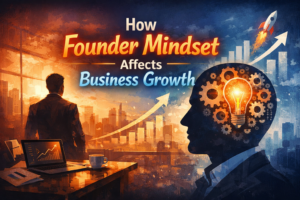
Most founders respond to stagnation by doing more. More hours. More tactics. More hires. More complexity. It’s the entrepreneurial instinct—to push harder when things aren’t moving. But here’s the uncomfortable truth: working harder on a broken internal framework just breaks you faster.
When a business stops growing, the symptoms are usually obvious. Flat revenue. Declining margins. Key people leaving. Customer acquisition costs climbing. But the root cause is rarely visible on a dashboard. It’s embedded in the founder’s decision-making patterns, emotional triggers, and subconscious programming.
I see this constantly in the founders I work with. They’re intelligent, driven, capable people who have built something real. But they’re also operating from internal belief systems formed decades ago beliefs about money, success, leadership, and self-worth that were never designed to support the level of growth they’re now trying to achieve.
A founder who subconsciously believes that “more success means more responsibility and less freedom” will unconsciously sabotage growth the moment it threatens that internal equilibrium. Not because they’re lazy or afraid of success, but because their nervous system is wired to protect them from a perceived threat. The business plateaus because the founder’s internal identity hasn’t expanded to match the external opportunity.
This is what I call a hidden growth constraint—a limitation that exists beneath the surface of strategy and operations, quietly dictating what the business is allowed to become.
The Harvard Business Review has noted that lasting behavioral change in leadership often requires addressing the internal mental patterns behind behavior rather than relying on discipline alone. When founders try to scale without addressing these internal patterns, they don’t just stall—they often create organizational chaos that mirrors their own unresolved internal conflicts.
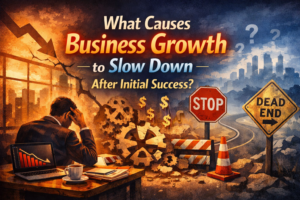
What Causes Business Growth to Slow Down After Initial Success?
Early-stage growth feels almost magical. Product-market fit clicks. Word spreads. Revenue climbs. The founder’s energy and vision carry everything forward. But then, somewhere between $1 million and $10 million in revenue, something shifts. The strategies that built the business stop working. The founder’s direct involvement becomes a bottleneck instead of an accelerator. Growth doesn’t just slow it feels like it’s fighting back.
This plateau isn’t random. It’s structural. And it’s deeply connected to founder mindset.
In the beginning, a founder’s personal capabilities—sales skills, product intuition, hustle, relationships—are enough to drive growth. The business is essentially an extension of the founder’s individual effort. But sustainable scaling requires a fundamental transition: from founder-dependent execution to systems-dependent operation. And that transition demands something most founders aren’t prepared for.
It demands that the founder let go of being the hero.
This is where mindset becomes the decisive factor. A founder whose identity is wrapped up in being the smartest person in the room, the one who solves every problem, the indispensable engine of the company, will unconsciously resist building systems that make them unnecessary. They’ll micromanage. They’ll hire people and then undermine them. They’ll create organizational structures that keep everyone dependent on their approval.
The business can’t scale because the founder’s ego is structurally invested in staying small enough to control.
Psychology Today research on identity-based behavioral change suggests that sustainable transformation happens when individuals shift who they believe they are, not just what they do. For founders, this means the transition from operator to leader isn’t a skill problem—it’s an identity problem. You can’t build a business that runs without you if you’re emotionally dependent on being needed by it.
How Do Founders Become Growth Bottlenecks Without Realizing It?
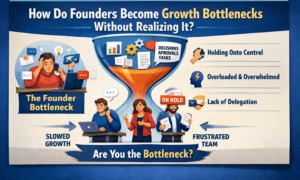
The most dangerous constraints are the ones you can’t see. And for most founders, the biggest invisible bottleneck is their own subconscious programming.
Every founder carries internal scripts about success, money, leadership, and worthiness. These scripts were written early shaped by childhood experiences, parental messages, early failures, cultural conditioning, and survival adaptations. They operate below conscious awareness, influencing decisions in ways that feel like “intuition” or “gut feeling” but are actually automated responses from an outdated internal map.
Here’s how this plays out in practice:
A founder with a subconscious belief that “rich people are greedy” will struggle to raise prices or ask for what they’re worth, even when the market would gladly pay more. They’ll leave money on the table and justify it as “staying humble” or “keeping things accessible.”
A founder who learned early that “authority figures are dangerous” will avoid making hard decisions, delay firing underperformers, and create a culture of passive-aggression rather than direct accountability. Their team becomes confused and disengaged, not because the strategy is wrong, but because the founder’s nervous system can’t tolerate the emotional discomfort of being the decisive leader the business needs.
A founder whose identity is built on “struggling to prove worth” will unconsciously create chaos and urgency even when things are stable. They’ll manufacture crises because calm success feels unfamiliar and threatening to their internal narrative. The business becomes a roller coaster not because the market demands it, but because the founder’s psychology requires it.
These aren’t character flaws. They’re protective mechanisms that made sense in a different context. But in the context of building a scalable, sustainable business, they become expensive liabilities.
According to McKinsey research on leadership effectiveness, the highest-performing executives are distinguished not by their technical skills but by their self-awareness and ability to manage their own internal states. For founders, this means the ceiling on your business is usually the ceiling on your emotional maturity.
What Is Founder Transformation, and Why Does It Matter More Than Strategy?
Founder transformation is the process of rewiring the internal beliefs, emotional patterns, and identity structures that govern how a founder shows up in their business. It’s not about becoming a different person. It’s about becoming the full version of yourself—unburdened by the subconscious limitations that have been running the show from the shadows.
This matters because strategy without internal alignment is expensive theater. You can have the perfect go-to-market plan, the ideal organizational structure, and the most sophisticated financial model. But if the person executing that strategy is operating from fear, scarcity, or unresolved identity conflicts, the execution will be distorted at every turn.
I’ve watched founders implement the exact same strategy with dramatically different results based entirely on their internal state. One founder, operating from confidence and clarity, makes bold decisions, trusts their team, and moves through uncertainty with grounded presence. Another founder, operating from anxiety and self-doubt, second-guesses every move, creates confusion through mixed signals, and burns out their best people with constant pivots.
Same strategy. Different internal operating system. Different outcome.
The SMT Method™—Subconscious Monetization Technology™—was developed specifically to address this gap. It works at the level of subconscious identity and emotional alignment, helping founders identify the hidden programming that has been limiting their growth and replace it with internal structures that support sustainable scaling. Unlike surface-level motivation or generic mindset advice, this approach creates lasting transformation because it changes who the founder believes they are, not just what they do.
When a founder transforms internally, the business transforms externally. Revenue ceilings dissolve not because of a new tactic, but because the founder no longer needs the ceiling to feel safe.
Why Do Successful Businesses Plateau Even When Nothing Seems Wrong?

The plateau is deceptive. From the outside, everything looks fine. Revenue is stable. The team is intact. Customers aren’t complaining. But inside, the founder feels it—a subtle deadness, a sense that the business has become a machine they’re maintaining rather than a vision they’re building.
This is the plateau of competence. The business works, but it doesn’t grow. The founder has become proficient at managing the current reality but has lost the capacity to create a new one.
Plateaus happen when the founder’s internal growth stops. The business is a mirror. It reflects the founder’s beliefs about what’s possible, what’s allowed, and what’s safe. When those beliefs hit a wall, the business hits a wall too.
I’ve seen founders stay at the same revenue level for years, cycling through different strategies, different hires, different markets—always hoping the next external change will be the one that breaks through. But the variable that never changes is them. Their internal ceiling stays fixed while everything else rotates around it.
Breaking through requires something most founders resist: looking inward with the same rigor they apply to their P&L. It means examining the emotional payoffs of staying stuck. It means asking uncomfortable questions about what success actually represents, and whether some part of you is terrified of finding out.
Sustainable growth isn’t about adding more complexity. It’s about removing the internal resistance that makes complexity necessary.
How Can Entrepreneurs Overcome Self-Sabotage and Scale Without Burnout?
Self-sabotage in founders rarely looks like obvious failure. It looks like success that never quite arrives. The deal that falls through at the last minute. The key hire who quits unexpectedly. The product launch that should have worked but didn’t. These aren’t always bad luck or market forces. Often, they’re the external manifestation of an internal conflict the founder hasn’t resolved.
The founder who fears visibility will unconsciously create PR disasters or social media controversies that keep them hidden. The founder who associates wealth with loss of relationships will engineer financial setbacks that keep them “humble” and connected to their origins. The founder who believes they don’t deserve success will achieve it and then systematically dismantle it through poor decisions and self-destructive behavior.
This is why scaling without burnout isn’t about time management or delegation techniques. It’s about internal safety. Can your nervous system handle the level of success you’re trying to build? Can your identity expand to include the version of yourself who leads a larger company, manages more wealth, and carries more influence?
If the answer is no, your psychology will find ways to bring you back down to a level that feels familiar. Burnout is often the body’s way of enforcing that boundary when the mind won’t.
The path through this isn’t to push harder. It’s to build internal capacity. This means doing the deeper work of identifying your subconscious programming, understanding the emotional logic behind your limitations, and gradually expanding your identity to include the next level of who you’re becoming.
Through the SMT Method™, founders learn to work with their subconscious rather than against it. Instead of white-knuckling through fear and resistance, they transform the internal structures that create the resistance in the first place. The result is growth that feels sustainable because it’s aligned with who they actually are, not who they’re pretending to be.
How Does Leadership Impact Business Growth Beyond Strategy and Tactics?
Leadership isn’t a role. It’s a frequency. The energy you bring into every interaction, every decision, every moment of uncertainty, ripples through your entire organization. Your team doesn’t just hear your words—they feel your internal state. And they calibrate their own behavior to match it.
A founder operating from anxiety creates an anxious organization. Decisions become defensive. Innovation stops because failure feels too dangerous. People hide problems instead of solving them. The culture becomes one of managed appearances rather than genuine excellence.
A founder operating from clarity and grounded confidence creates an organization where people feel safe to take risks, challenge assumptions, and own their work. Growth becomes organic because the system isn’t spending all its energy managing the founder’s emotional volatility.
This is why leadership development isn’t a nice-to-have add-on to business strategy. It’s the foundation everything else builds on. Your capacity to hold uncertainty without collapsing into control determines how much uncertainty your business can navigate. Your ability to receive feedback without defensiveness determines how quickly your organization can learn and adapt. Your willingness to be wrong determines how right your team can become.
According to research from Stanford Graduate School of Business, the most significant predictor of entrepreneurial success isn’t IQ, education, or even industry experience—it’s the founder’s ability to manage their own internal state under pressure. This isn’t about suppressing emotion or projecting false positivity. It’s about developing the internal architecture to hold complexity without losing yourself in it.
Leadership capacity is the ultimate growth constraint because it determines how much of everything else you can actually use. More capital, more talent, more opportunity—all of it becomes destructive if the leader can’t metabolize it.
What Are Hidden Growth Constraints, and How Do You Identify Them?
Hidden growth constraints are the internal and structural limitations that prevent a business from scaling, even when external conditions are favorable. They’re “hidden” because they don’t show up on financial statements or operational dashboards. They live in the spaces between people, in the unspoken assumptions, in the founder’s blind spots.
Some common hidden growth constraints include:
Founder dependency. The business can’t function without the founder’s direct involvement in daily decisions. This usually stems from the founder’s need for control or their unconscious belief that they’re the only one who can do things right.
Misaligned team capacity. The people who helped you get to $2 million often aren’t the people who can get you to $20 million. But founders delay making hard personnel decisions because of loyalty, guilt, or fear of conflict.
Subconscious revenue ceilings. The founder has an internal number—often formed in childhood based on parental income, cultural messages, or early financial trauma—that represents “enough” or “too much.” When revenue approaches that number, the founder unconsciously creates obstacles to push it back down.
Emotional avoidance patterns. The founder avoids difficult conversations, financial reviews, or strategic decisions because the emotional discomfort is too great. This creates organizational drift where important issues fester until they become crises.
Identity misalignment. The founder is trying to build a $50 million company while emotionally identifying as someone who runs a $5 million company. The gap creates constant internal friction that manifests as inconsistent execution and self-sabotage.
Identifying these constraints requires honest self-assessment and usually external perspective. Most founders can’t see their own blind spots because they’re standing inside them. This is why working with a business growth consultant or transformational coach who understands the intersection of psychology and business strategy can accelerate breakthroughs that would take years to achieve alone.
How Can a Business Growth Consultant Help You Break Through Revenue Ceilings?
A skilled business growth consultant does more than analyze your market and recommend tactics. They help you see the patterns you can’t see. They ask the questions you’ve learned not to ask yourself. They hold up a mirror that reflects not just your business, but the internal architecture that built it.
The right consultant doesn’t just hand you a strategy—they help you become the person who can execute it. They understand that revenue ceilings are rarely about market saturation or competitive pressure. They’re about the founder’s capacity to hold more success without imploding.
In my work with founders through the SMT Method™, the breakthroughs that matter most aren’t the tactical wins. They’re the moments when a founder realizes they’ve been operating from a belief that was never true. When they see how their childhood experience of financial instability created an adult pattern of hoarding control. When they recognize that their resistance to delegation isn’t about standards—it’s about terror of being unnecessary.
These realizations don’t just change how the founder runs their business. They change who the founder is. And when the founder changes, the business has no choice but to change with them.
If you’re hitting a ceiling that doesn’t make logical sense, if you’re working harder than ever with diminishing returns, if you sense that the next level requires something from you that you don’t currently have—consider that the problem might not be out there in the market. It might be in here, in the internal landscape you haven’t fully explored.
Common Mistakes Founders Make When Trying to Scale
Even well-intentioned founders fall into predictable traps when pursuing growth. Understanding these mistakes can save you years of frustration and costly missteps.
Mistake 1: Chasing tactics instead of capacity. Every month there’s a new “must-use” strategy—TikTok ads, AI automation, outbound systems. Founders hop from tactic to tactic hoping one will be the magic bullet. But tactics only work when the founder has the internal capacity to implement them consistently. Without that capacity, every tactic becomes another abandoned project.
Mistake 2: Hiring for current pain instead of future structure. Founders often hire reactively—bringing someone in to fix an immediate problem without considering how that role fits into the organization’s future architecture. This creates Frankenstein teams that work hard but never quite gel.
Mistake 3: Confusing busyness with progress. Working 80-hour weeks feels like commitment, but it’s often avoidance. Busy founders don’t have to face the uncomfortable strategic questions that sitting still would force them to confront. The hustle becomes a hiding place.
Mistake 4: Ignoring the emotional cost of growth. Scaling a business is emotionally expensive. It requires saying no to people you care about, making decisions with incomplete information, and tolerating periods of uncertainty that would break most people. Founders who don’t build emotional resilience don’t just burn out—they often damage their relationships and health in ways that take years to repair.
Mistake 5: Trying to out-strategy their psychology. You can’t spreadsheet your way out of a self-worth problem. The most sophisticated financial model in the world won’t help if you’re unconsciously committed to staying small. Strategy is important, but it’s secondary to the internal alignment that makes strategy executable.
Practical Takeaways: How to Start Shifting Your Founder Mindset Today
Transformation doesn’t require a complete life overhaul. It starts with small, consistent practices that build awareness and expand capacity over time.
Audit your internal narrative. For one week, notice the automatic thoughts that arise when you think about growth, money, leadership, and success. Don’t judge them—just observe. You’ll likely discover patterns that have been running in the background for decades.
Identify your revenue thermostat. What’s the number where things always seem to get “complicated”? Where do you unconsciously slow down or create obstacles? Awareness of this pattern is the first step toward changing it.
Practice making decisions from your future self. When facing a difficult choice, ask: what would the version of me who already has the business I want do? This isn’t fantasy—it’s identity rehearsal. You’re training your nervous system to recognize a new version of yourself as safe and familiar.
Build your tolerance for uncertainty. Growth lives in the space between what you know and what you don’t. Start small—delegate a decision you’d normally make yourself, launch before you feel ready, have a conversation you’ve been avoiding. Each small act of courage expands your capacity for the bigger ones.
Invest in your internal operating system. Read deeply. Work with someone who understands the psychology of entrepreneurship. Do the subconscious work that most founders avoid because it feels less concrete than strategy. Your internal growth is the highest-leverage investment you can make.
Frequently Asked Questions
How does founder mindset affect business growth?
Founder mindset affects business growth by determining the founder’s capacity to make bold decisions, tolerate uncertainty, delegate effectively, and expand their identity to match the business’s potential. A founder’s subconscious beliefs about success, money, and leadership create invisible ceilings that limit what the business can become, regardless of external strategy or market conditions.The Founder’s Mindset: Key Habits for Startup Success
Why do successful businesses plateau?
Businesses plateau when the founder’s internal growth stops. The business is a mirror of the founder’s beliefs about what’s possible and safe. When those beliefs hit a ceiling, the business hits a ceiling too. External factors like market conditions matter, but the primary driver of plateaus is usually the founder’s unresolved internal constraints and identity limitations. Read more on
Why Good Businesses Plateau what’s usually behind it What are hidden growth constraints?
Hidden growth constraints are internal and structural limitations that prevent scaling even when external conditions are favorable. They include founder dependency, subconscious revenue ceilings, emotional avoidance patterns, misaligned team capacity, and identity misalignment. These constraints don’t appear on financial statements but govern the business’s trajectory from beneath the surface. Get more on
how you can grow your business How can entrepreneurs overcome self-sabotage?
Entrepreneurs overcome self-sabotage by identifying the subconscious beliefs and emotional patterns driving their limiting behaviors. This requires honest self-assessment, often with external support from a coach or consultant who can see blind spots. Transformation happens when founders understand the emotional logic behind their limitations and gradually expand their identity to include new levels of success. Learn
Why Entrepreneurs Sabotage Their Own Success (and How to Stop it)
What is the SMT Method, and how does it help founders grow?
The SMT Method™ (Subconscious Monetization Technology™) is a transformational coaching framework developed by Joseph Drolshagen that works at the level of subconscious identity and emotional alignment. It helps founders identify hidden programming that limits growth and replace it with internal structures that support sustainable scaling. Unlike surface-level motivation, the SMT Method™ creates lasting transformation by changing who the founder believes they are.
How can a business owner scale without burnout?
Scaling without burnout requires building internal capacity, not just external systems. Founders need to develop emotional resilience, expand their identity to hold more success, and address the subconscious patterns that create chronic urgency and anxiety. When internal alignment precedes external expansion, growth feels sustainable rather than depleting. Learn the full guide on how to grow without burnout
Conclusion: The Real Work of Growth Happens Inside First
If you take one thing from this article, let it be this: your business is not separate from you. It’s an extension of your internal world—your beliefs, your fears, your capacity, your blind spots. Every ceiling you’ve hit, every plateau you’ve endured, every moment of frustration where the external strategy should have worked but didn’t—it’s all pointing to the same truth.
The real work of growth happens inside first.
You don’t need another tactic. You need a deeper understanding of the internal architecture that’s been running your decisions from the shadows. You need the courage to look at the parts of yourself that have been protecting you from success because some old part of you decided success wasn’t safe. You need to become the person who can hold the business you’re trying to build.
This isn’t easy work. It’s not fast. It doesn’t fit neatly into a quarterly plan. But it’s the only work that actually moves the needle on sustainable, scalable, fulfilling growth.
I’ve watched founders go from stuck and exhausted to clear and expansive—not because they found a magic strategy, but because they finally addressed the internal constraints that had been limiting them for years. The SMT Method™ exists because I believe every founder deserves to build something extraordinary without sacrificing themselves in the process.
Your business is waiting for you to become who it needs you to be. The question isn’t whether you’re capable. The question is whether you’re willing to do the inner work that makes the outer results inevitable.
If you’re ready to stop hitting the same ceiling and start building the business and the life you actually want, let’s talk. The next level of your growth is closer than you think. It just starts in a different place than you’ve been looking.
Sources & Further Reading
-
-
Psychology Today. “Identity-Based Behavioral Change and Sustainable Transformation.”
Psychology Today
-
McKinsey & Company. “Leadership Effectiveness and Self-Awareness in High-Performing Executives.”
McKinsey
-
Stanford Graduate School of Business. “Emotional Regulation and Entrepreneurial Success: The Hidden Predictor.”
Stanford GSB
-
Joseph Drolshagen. “How Derek Experienced Business and Mindset Transformation Through the SMT Method.”
Joseph Drolshagen
-
Positive Talk Radio. “How Dr. Joseph Drolshagen Helps Leaders Unlock Rapid Growth with SMT Method™.”
Positive Talk Radio
-
Brainz Magazine. “Helping Realtors and Business Owners Across the Nation: Interview with Joseph Drolshagen.”
Brainz Magazine
-
HubSpot. “The State of Business Growth: Why Mindset Matters More Than Tactics.”
HubSpot
For More Head Full