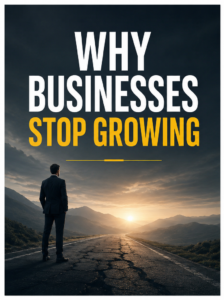
Why Businesses Stop Growing: Every business owner starts with a vision of growth.
In the early stages, momentum often comes naturally. New customers arrive, revenue increases, and opportunities seem endless. Then something unexpected happens.
Growth slows, which is way will will want to ask
Sales become inconsistent. Teams become less productive. Revenue plateaus. The same strategies that once produced results no longer seem effective.
If you’ve ever wondered why businesses stop growing, you’re not alone.
Many entrepreneurs initially assume the problem is external—economic uncertainty, competition, marketing challenges, or changing customer behavior. While these factors can certainly contribute, Joseph Drolshagen’s experience working with entrepreneurs and business leaders reveals a deeper truth:
Most businesses stop growing because the founder, leadership team, systems, or business model have not evolved at the same pace as the company.
Understanding this distinction is often the first step toward sustainable growth.
For business owners seeking long-term success, the challenge is not simply growing the company. The challenge is becoming the type of leader capable of guiding the company through its next stage of growth.
What Does It Mean When a Business Stops Growing?
A business doesn’t necessarily stop growing when revenue declines.
More often, growth stalls when:
- Revenue remains flat year after year
- Customer acquisition slows
- Team productivity decreases
- Decision-making becomes reactive
- Innovation slows
- Profit margins shrink
- Leadership becomes overwhelmed
In many cases, the business appears successful from the outside while struggling internally.
According to research from McKinsey & Company, organizations that continuously adapt leadership and operational capabilities outperform those that rely solely on past success patterns.
Quick Summary
A business stops growing when its current leadership, systems, or strategy can no longer support the next stage of expansion.
Why Businesses Stop Growing: The Leadership Ceiling
One of the most overlooked growth barriers is leadership capacity.
When a company is small, founders often make every major decision.
As the company grows, this approach becomes unsustainable.
The founder who once managed everything personally may become:
- A bottleneck
- Overwhelmed by responsibilities
- Resistant to delegation
- Focused on daily operations rather than strategic growth
This concept aligns closely with Joseph Drolshagen’s work on leadership transformation and business growth strategy.
Many entrepreneurs mistakenly believe their company needs better marketing, more salespeople, or additional products.
In reality, the business may need a stronger leadership structure first.
For a deeper understanding of growth-focused leadership, explore Joseph’s insights as a Business Growth Specialist
Quick Summary
Businesses often stop growing when leadership habits that created initial success become limitations at higher levels of growth.
The Founder Mindset Problem
Many growth challenges begin internally before they become operational problems.
Fear of risk.
Fear of delegation.
Fear of failure.
Fear of success.
These mindset barriers quietly influence decisions and create growth limitations.
Joseph frequently discusses how founder transformation impacts business performance. In his article on How Founder Mindset Shapes Business Success, he explains that business growth often mirrors personal growth.
Consider two business owners:
Founder A
- Delegates responsibility
- Invests in leadership development
- Embraces strategic change
Founder B
- Controls every decision
- Avoids difficult conversations
- Resists new approaches
Over time, Founder A creates scalability while Founder B creates dependency.
The difference isn’t intelligence.
It’s mindset.
Quick Summary
Business growth frequently stalls when founders stop evolving personally and professionally.
Systems vs. Hustle: Why Growth Becomes Harder
In the beginning, hustle can compensate for weak systems.
As businesses grow, hustle alone becomes expensive.
Founders often find themselves working:
- Longer hours
- More weekends
- More meetings
Yet results remain stagnant.
This usually indicates a systems problem.
Common System Failures
- No documented processes
- Poor delegation structures
- Inefficient communication
- Lack of accountability
- Weak performance tracking
Businesses that rely solely on individual effort eventually reach capacity.
Businesses built on scalable systems continue growing.
Research from Harvard Business Review consistently highlights the importance of scalable operating systems and leadership alignment in organizational growth.
Quick Summary
Hustle creates momentum. Systems create sustainable growth.
Comparison: Growing Businesses vs. Stagnant Businesses
| Growing Businesses | Stagnant Businesses |
|---|---|
| Delegate effectively | Founder controls everything |
| Focus on strategy | Focus only on daily operations |
| Invest in leadership | Avoid leadership development |
| Track key metrics | Operate on assumptions |
| Embrace innovation | Resist change |
| Build scalable systems | Depend on individual effort |
| Encourage accountability | Tolerate inconsistency |
This comparison highlights a critical reality:
Growth is rarely accidental.
It is usually the result of intentional leadership and operational decisions.
Why Revenue Growth Eventually Slows
Many business owners assume that increasing sales automatically solves growth problems.
However, revenue growth without organizational growth creates new challenges.
Examples include:
- Customer service breakdowns
- Employee burnout
- Cash flow issues
- Operational inefficiencies
The goal is not simply higher revenue.
The goal is sustainable revenue acceleration.
This is one reason Joseph’s approach focuses on both business performance and leadership evolution rather than revenue alone.
For entrepreneurs wondering how coaching contributes to growth, his article on What Does a Business Growth Coach Do? provides valuable insight.
Quick Summary
Revenue growth without leadership and operational growth often creates new limitations.
A Practical Framework to Restart Growth
When businesses stop growing, leaders should evaluate four areas:
1. Leadership
Ask:
- Am I leading strategically?
- Am I developing future leaders?
2. Mindset
Ask:
- What assumptions are limiting growth?
- What fears are influencing decisions?
3. Systems
Ask:
- Can the business operate effectively without constant founder involvement?
4. Strategy
Ask:
- Is our current growth strategy still relevant?
Addressing these four areas often reveals hidden opportunities that marketing tactics alone cannot solve.
Key Takeaways
- Most businesses stop growing because leadership, systems, and mindset fail to evolve.
- Revenue plateaus are often symptoms, not root causes.
- Founder transformation directly influences business performance.
- Scalable systems create sustainable growth.
- Leadership development remains one of the strongest predictors of long-term success.
- Strategic growth requires continuous adaptation.
Frequently Asked Questions
Why do successful businesses suddenly stop growing?
Successful businesses often stop growing because leadership, systems, and strategy fail to evolve as the company expands. Lean Business Growth with Joseph Drolshagen
What is the most common reason businesses stop growing?
The most common reason is leadership limitations. Founders frequently become bottlenecks when they continue operating as if the business were still in its startup stage. Learn the 17 reasons businesses stop growing
Can business coaching help restart growth?
Yes. Effective business coaching helps identify blind spots, improve leadership effectiveness, strengthen accountability, and develop growth strategies aligned with long-term goals. Learn more about the power of business coaching
How does mindset affect business growth?
Mindset influences decision-making, risk tolerance, leadership behavior, and innovation. Limiting beliefs often create invisible barriers to growth. Get more on how founder mindset shift businesse sucess
What role do systems play in business growth?
Systems allow businesses to scale efficiently by reducing dependency on individual effort and creating consistent execution. Get more on the importance of systems in businesses fueling growth
How can entrepreneurs become better growth leaders?
Entrepreneurs can improve by investing in leadership development, building strong teams, improving self-awareness, and focusing on strategic thinking rather than daily firefighting. Mastering leadership skills for business growth and success
Conclusion
Understanding why businesses stop growing requires looking beyond revenue numbers and market conditions.
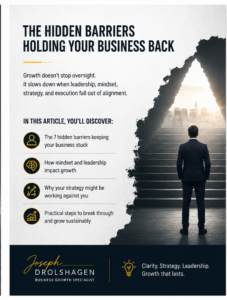
In many cases, the true obstacles are leadership limitations, founder mindset challenges, weak systems, and outdated strategies.
The encouraging news is that these barriers can be overcome.
Businesses that continue growing are not necessarily smarter, luckier, or better funded. They are often led by individuals willing to evolve alongside their companies.
As Joseph Drolshagen consistently teaches, sustainable business growth begins with leadership growth. When founders transform the way they think, lead, and execute, they create the foundation for long-term success, stronger teams, and meaningful revenue acceleration.
Ready to Break Through Your Growth Ceiling?
If your business has reached a plateau and you’re looking for practical strategies to accelerate growth, strengthen leadership, and create sustainable momentum, explore Joseph Drolshagen’s Business Growth Specialist resources, and there you can get more headfull
Your next level of business growth may begin with your next level of leadership.