Scaling a consulting business isn’t just about signing more clients. It is about increasing revenue, improving profitability, and delivering consistent results without proportionally increasing your workload, operating costs, or dependence on the founder.
For established consultants, entrepreneurs, and business owners, the challenge often begins when a proven service reaches a revenue ceiling. There are only so many hours available, client demands keep growing, and the founder becomes responsible for sales, delivery, team management, and strategic decisions.
The solution is to build a consulting business that grows through systems, leadership, leverage, and repeatable value—not endless personal effort.
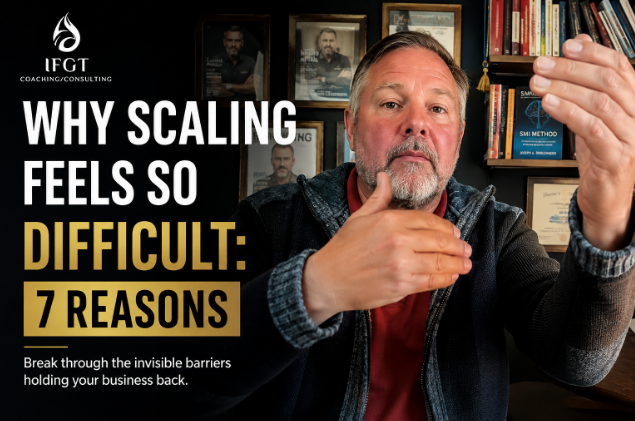
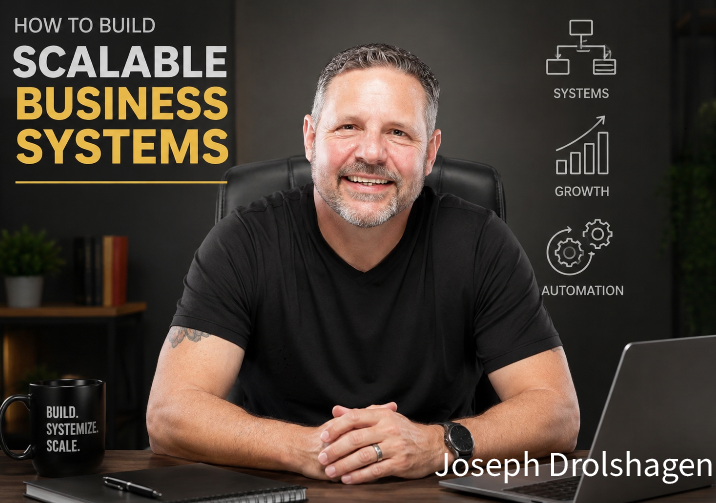
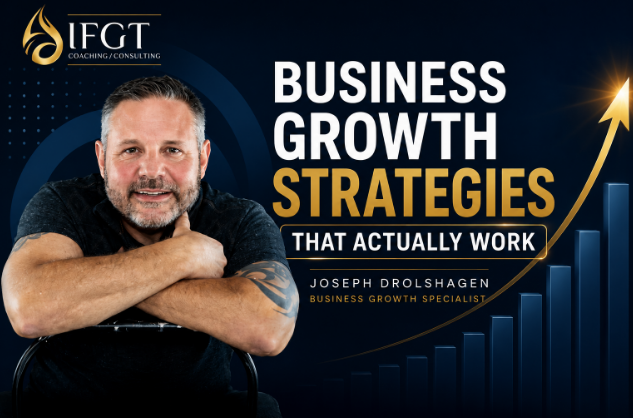
Joseph Drolshagen, business growth coach and founder of IFGT Coaching Consulting, helps entrepreneurs address the mindset, leadership, and performance barriers that can restrict business growth. Through his SMT Method™, Joseph focuses on aligning internal patterns with purposeful action to support revenue acceleration, leadership development, and sustainable entrepreneurial success.
Table of Contents
- Growth vs. Scaling a Consulting Business
- Build a Scalable Consulting Business Model
- Automate Operations and Delegate Effectively
- Strengthen Your Revenue Growth Strategy
- Develop a Leadership Mindset for Scale
- Measure Profitability and Sustainable Growth
- Frequently Asked Questions
- Key Takeaways

Growth vs. Scaling a Consulting Business
First, understand the difference between growth and scaling.
Growth typically involves adding resources to generate additional revenue. You may hire more consultants, accept more projects, or increase your marketing budget. Although these actions can increase sales, they can also increase expenses and complexity.
Scaling, by contrast, means increasing revenue without a proportional increase in costs and operational demands.
For example, a consultant who doubles revenue by doubling personal working hours has achieved growth, but not necessarily scalable growth. However, a consulting firm that standardizes delivery, trains its team, and improves client acquisition can serve more customers without doubling its workload.
Consequently, sustainable business growth requires a different approach to business design.
Joseph Drolshagen’s business coaching approach emphasizes identifying the constraints that prevent entrepreneurs from progressing. Instead of automatically working harder, founders should determine which systems, decisions, or leadership habits are limiting their next stage of growth.
Build a Scalable Consulting Business Model
A scalable business model allows you to deliver valuable outcomes repeatedly without rebuilding the entire service for every client.
To begin, evaluate which parts of your consulting service require customization and which can follow a consistent framework.
Consider these business scaling strategies:
- Standardize delivery: Create repeatable onboarding procedures, project milestones, templates, and quality-control checklists.
- Package your expertise: Turn recurring client problems into clearly defined consulting offers with specific deliverables and boundaries.
- Introduce leveraged services: Where appropriate, combine one-to-one consulting with group programs, workshops, retainers, or digital resources.
- Document your intellectual property: Develop frameworks, training materials, and processes that qualified team members can use consistently.
Nevertheless, customization does not have to disappear. The objective is to standardize the delivery process while tailoring recommendations to each client’s circumstances.
For more guidance, read Joseph Drolshagen’s related resource, How to Scale a Business Sustainably. It complements this article by exploring how entrepreneurs can build a business that supports continued expansion without sacrificing personal freedom.
Automate Operations and Delegate Effectively
Next, address business operational efficiency.
Many consulting firms experience growth bottlenecks because routine work consumes the founder’s attention. Scheduling, proposal preparation, client onboarding, reporting, invoicing, and follow-up can all become time-consuming when handled manually.
Business process automation helps reduce this friction.
Start by identifying repetitive tasks that follow predictable rules. Depending on your business, customer relationship management software, automated scheduling, proposal templates, project management platforms, and reporting tools can eliminate unnecessary administration.
However, automation alone will not solve every operational problem. Processes must be clearly defined before technology can improve them.
Delegation for business owners is equally important. Assign responsibility for recurring activities to capable team members, establish measurable expectations, and create a process for reviewing results.
Rather than approving every decision, define which decisions employees can make independently and when escalation is necessary.
This approach reduces founder dependency, improves team accountability, and creates capacity for higher-value activities such as strategy, partnerships, and business development.
Strengthen Your Revenue Growth Strategy
A scalable consulting business needs a repeatable way to attract, convert, retain, and expand client relationships.
Instead of pursuing every possible lead, examine your existing revenue engine.
Start with customer acquisition. Calculate your customer acquisition cost (CAC), including relevant marketing and sales expenses. Then compare that cost with the revenue and gross profit generated by new clients. Lower acquisition costs can improve profitability, provided lead quality and service standards remain strong.
Next, improve conversion rates. Review how prospects discover your services, evaluate your expertise, and decide to buy. Strong positioning, relevant case studies, clear proposals, and a consistent sales process can help qualified prospects make informed decisions.
Then, increase customer lifetime value (LTV). Consider whether clients benefit from ongoing advisory services, additional projects, strategic reviews, or complementary offers. Retention and expansion can create more value from established relationships without requiring a completely new customer for every sale.
Finally, optimize pricing and capacity. If your expertise consistently creates valuable outcomes, evaluate whether your pricing reflects the value delivered, the complexity involved, and your market position.
These actions provide a practical framework for how to increase business revenue while protecting business growth and profitability.
The objective is not to sell indiscriminately. Instead, develop a revenue growth strategy that aligns the right clients, appropriate pricing, consistent delivery, and long-term relationships.
Develop a Leadership Mindset for Scale
Even a well-designed business model can struggle when the founder’s habits and beliefs reinforce the old way of operating.
For instance, an entrepreneur may believe that every important client relationship requires personal involvement. Another may hesitate to delegate because mistakes feel too costly. Others may avoid raising prices, hiring experienced leaders, or pursuing larger opportunities because uncertainty feels uncomfortable.
These patterns can influence decisions, even when the business strategy looks sound.
That is why leadership development and founder transformation matter alongside operational improvements.
Joseph Drolshagen’s SMT Method™—identified on his website as Subconscious Monetization Technology™—focuses on the subconscious patterns and behavioral barriers that can influence performance, confidence, and decision-making. His coaching integrates this mindset work with business growth objectives and practical action.
The goal is not to replace sound business strategy with positive thinking. Rather, it is to help entrepreneurs recognize unproductive patterns and develop the confidence, clarity, and accountability needed to execute effective strategies.
Through IFGT Coaching Consulting, Joseph supports business owners working toward stronger leadership, revenue acceleration, and greater independence from daily operational demands.
As a founder, ask yourself: Am I building a business that depends on my constant involvement, or am I developing people and systems that can deliver results without me?
Your answer can reveal an important scaling opportunity.
Measure Profitability and Sustainable Growth
Revenue growth alone does not prove that a consulting business is becoming healthier.
To make informed decisions, monitor a focused set of performance indicators:
- Revenue growth: Is income increasing consistently across relevant periods?
- Gross and operating profit margins: Are you retaining more value after delivery costs and operating expenses?
- Customer acquisition cost: How much does it cost to acquire a qualified client?
- Customer lifetime value: How much value does a typical client relationship generate over time?
- Client retention and referrals: Are clients returning, renewing, or recommending your services?
- Delivery capacity: Can your team serve additional clients without lowering quality?
- Founder dependency: Can routine operations and client delivery continue when you are unavailable?
Review these metrics regularly and connect them to specific decisions. For example, if revenue rises but profit margins fall, examine pricing, delivery hours, staffing, and project scope before investing in additional marketing.
Similarly, if demand exceeds capacity, improve workflows and team utilization before committing to expensive expansion.
Scaling a business without increasing costs in direct proportion to revenue is a useful objective, but not every cost should remain fixed. Strategic investments in people, systems, and technology may be necessary to support the next stage.
The aim is sustainable business growth: profitable expansion that preserves service quality, financial resilience, and leadership capacity.
Frequently Asked Questions
How do you scale your consulting business?
Start by identifying the activities that limit revenue or consume the founder’s time. Then standardize service delivery, automate repeatable tasks, delegate responsibilities, improve client acquisition, and track profitability. A scalable consulting business combines repeatable systems with strong leadership and a clear revenue strategy.
How do you scale customized consulting services?
Standardize the process, not every recommendation. Use a consistent framework for discovery, onboarding, analysis, delivery, and reporting while tailoring the solution to each client. Reusable templates, specialist teams, documented methodologies, and well-defined service packages make customized consulting easier to deliver at scale.
Is scaling a consulting firm a model problem?
Sometimes. If revenue depends entirely on billable founder hours, the business model may limit growth. However, the underlying issue can also involve pricing, positioning, sales conversion, delivery processes, delegation, or leadership. Diagnose the actual bottleneck before changing the model.
Which consultants scale the most successfully?
Consultants with a clearly defined target market, a valuable and repeatable service, consistent lead generation, healthy margins, documented delivery systems, and capable teams often have stronger foundations for scaling. Success also depends on market demand, execution, client outcomes, and the firm’s ability to adapt without compromising quality.
Key Takeaways
Scaling a consulting business requires more than additional clients. It requires a business structure that can generate greater revenue and value without creating a proportional increase in complexity.
Remember these principles:
- Build repeatable systems before increasing volume.
- Automate predictable tasks and delegate responsibilities with clear accountability.
- Improve your revenue engine through better positioning, conversion, retention, and pricing.
- Measure profitability, customer acquisition cost, customer lifetime value, and delivery capacity.
- Develop leadership and mindset so the founder can move from doing everything to building a capable organization.
- Prioritize sustainable growth over revenue increases that create financial pressure or personal burnout.
Joseph Drolshagen’s business coaching and IFGT Coaching Consulting approach combines the SMT Method™ with leadership development and revenue-focused strategy to help entrepreneurs address the barriers that may be holding them back.
If your consulting firm has reached a revenue ceiling, the next step may not be more hours or more marketing. It may be a better system, a stronger team, a clearer strategy, or a different approach to leadership.
Explore Joseph Drolshagen’s business coaching services to learn how coaching and consulting can support your next stage of growth.
Build a business designed to multiply—not one that requires you to do everything.